For foreigners changing jobs (tenshoku) in Japan, an interview is more than just a Japanese language test; it’s the "closing deal" to determine if you are the person the company wants to work with.
This article compiles everything you need: the right mindset for the interview, how to prepare, common Japanese interview questions with sample answers, etiquette for the interview day (both in-person and online), and a pre-interview checklist.
What is actually being evaluated in a Japanese interview?
The most important thing in an interview is what cannot be read from your resume. Your experience will certainly be scrutinized, but much of that was already checked during the document screening phase. What they look at more closely is: who you are as a person. Your enthusiasm for the company and the role, your values, your cultural fit, and your communication skills during the interaction. In short, the big question at every interview is: "Is this someone I want to work with?" Once you realize this, you'll stop memorizing answers and start having a conversation like a future colleague.
Difference between the screening round and the interview round
The most common number of interview rounds when changing jobs is two, though it can vary from one to three depending on the company. Sometimes these are accompanied by aptitude tests, take-home assignments, or SPI tests. Each round usually lasts between 30 minutes to an hour. Key point: the interviewers in each round hold different positions, so what they are looking for also differs.
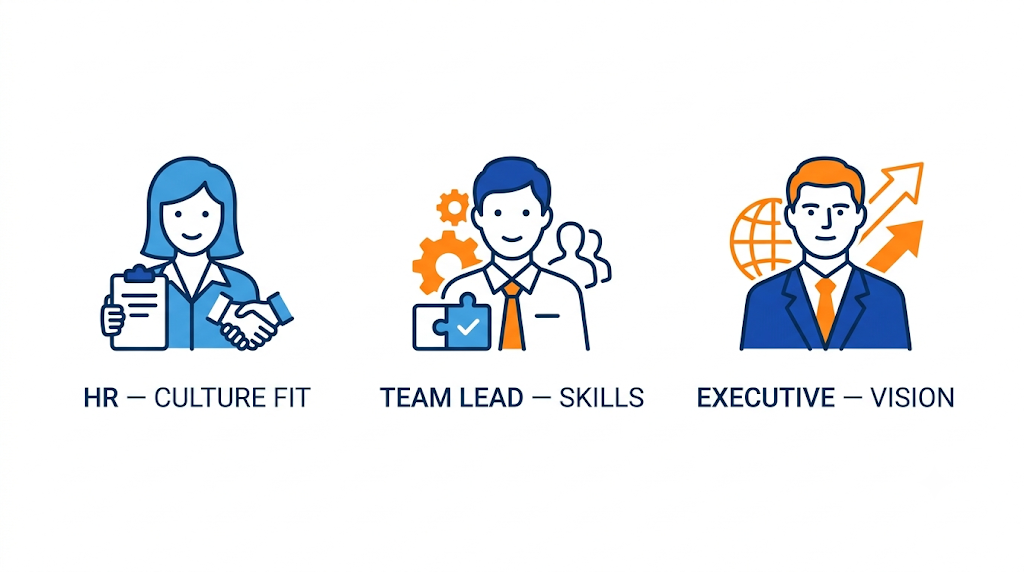
Who is interviewing you and what are they looking for?
Human Resources (HR), Rounds 1–2: Personality, potential for long-term commitment, whether communication is smooth, and culture fit.
Department Manager/Hiring Manager, Rounds 1–2: Practical skills and experience, core thinking process, ability to articulate achievements and the reasons behind your success. Executive Management, Round 2 – Final: Ambition, vision, alignment with the company’s direction, and consistency with previous rounds.
Knowing who will interview you at each stage helps you prepare exactly what they need to hear.
💡 An interview progresses through a dialogue between you and the interviewer. Focusing too much on pushing your "Self-PR" to the point where the conversation feels out of sync is a mistake. Interviewers are human; if you can create a comfortable atmosphere for both parties, your evaluation will naturally improve. Eye contact and keeping a smile are two small but vital things.
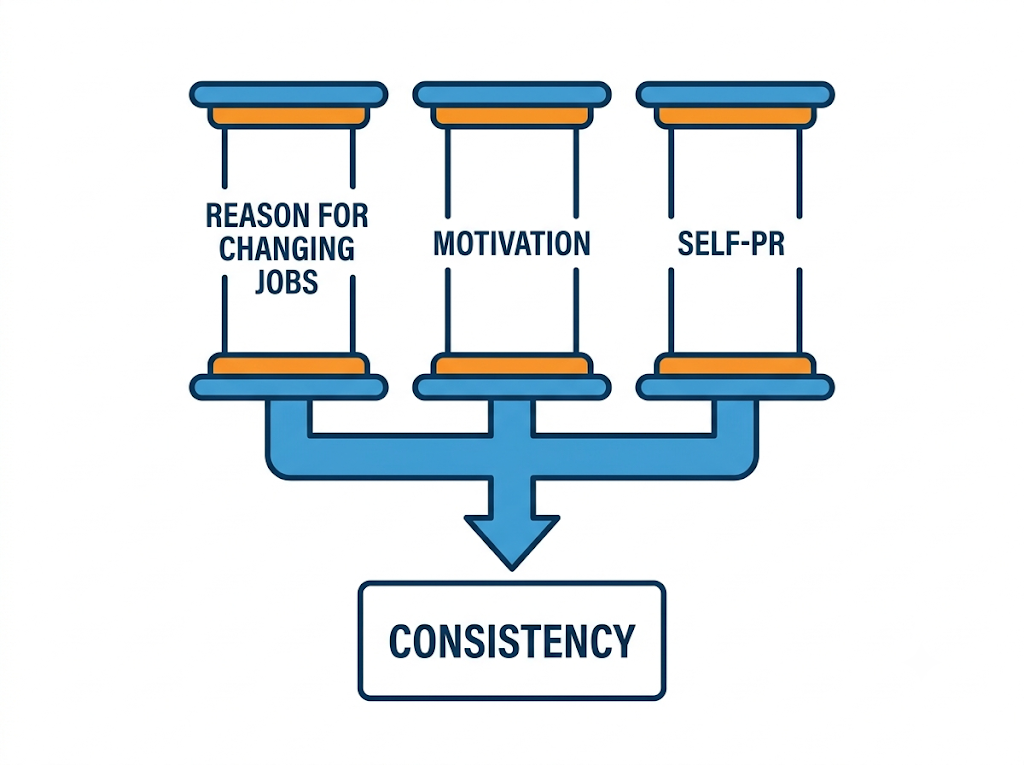
The 3 pillars of every answer
This is the most critical principle that determines whether you leave a "reliable" impression. The three main points you PR throughout the interview must be logically aligned:
Reason for leaving: What you want to achieve through this career change.
Motivation for applying: Why this specific company?
Self-PR: What you can contribute to the company.
If these three pillars point in different directions, the interviewer will not feel confident in hiring you. Think of the interview as a presentation where you prove that hiring you benefits both the company and yourself.
💡 Connect the logic: Benefit for you ⇄ Benefit for the company = Rationality of hiring.
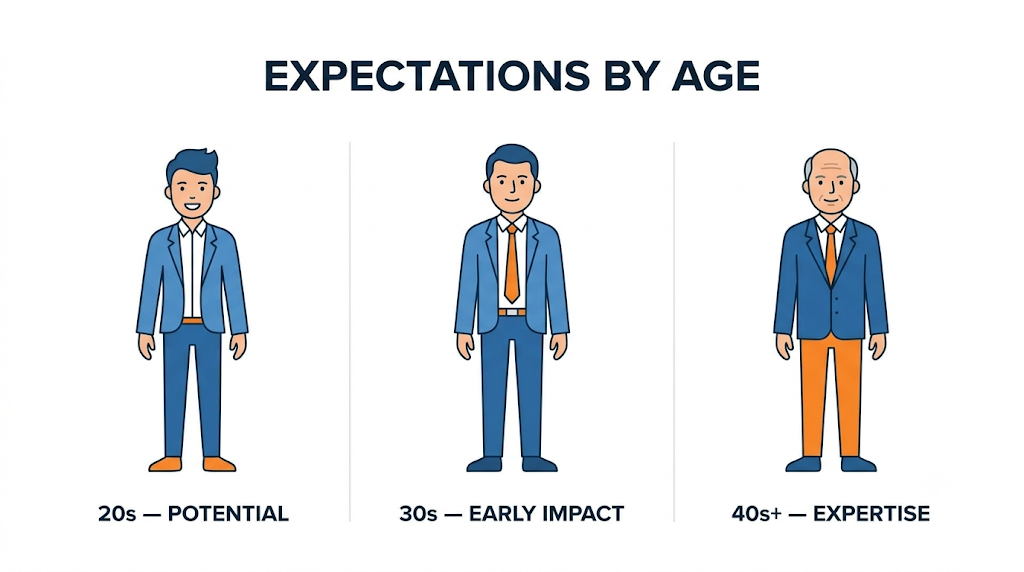
Expectations vary by age
Candidates in their 20s / Low experience: Show how you differ from new graduates. Besides basic manners, showcase your proactivity, drive for growth, and ability to think independently to create an impression that you are "ready to use." Employers expect you to require less training costs than a fresh graduate.
Candidates in their 30s: Prove you can make an impact quickly. You are expected to deliver results faster than someone in their 20s. Beyond personal growth, clearly articulate "what you can do within the organization" and "how you want to contribute." Prepare stories of solving organizational problems based on data and figures, not just intuition.
Candidates aged 40 and over: Showcase deep knowledge and experience. Your life and work experience are significantly higher, so you need to understand the skills the company needs and propose solutions for the organization's challenges. Your adaptability to the company culture will also be closely watched. Don't just boast about skills; demonstrate cooperativeness and a humble attitude.
Preparation: Company research and practice
No matter how good your skills are, failing to prepare makes it hard to pass. The two mandatory tasks before the interview are company research and speaking practice.
Targeted company research
Company research (企業研究 - kigyou kenkyuu) can easily become endless, so focus on these three axes:
Past – Present – Future: History, size, industry position, and especially future development directions and company vision.
Business content and strengths: How the company makes money, "what" they sell, to "whom," in "what way," and how they outperform competitors.
Company culture: What kind of people and mindset the company welcomes. If there are employee interview articles or columns posted by the company, read them all; they are goldmines for writing a persuasive motivation.
💡 If possible, personally experience the company's products or services. A sentence like "I tried service X and found..." carries more weight than any generic compliment.
Practice speaking naturally, not by rote
On the day of the interview, communicate with sincerity rather than just "reciting a script." Memorizing entire paragraphs can make you sound robotic. Instead:
Remember by keywords: Memorize the "conclusion you want to say for each sentence" rather than the whole paragraph.
Practice output: If you tend to speak for too long, time yourself; if you're shy about smiling, practice in front of a mirror or record a video to review.
Do mock interviews: Share your weak points beforehand so the simulation has a goal, and ask for feedback on your speaking speed, gestures, and expressions.
Common Japanese interview questions and how to answer
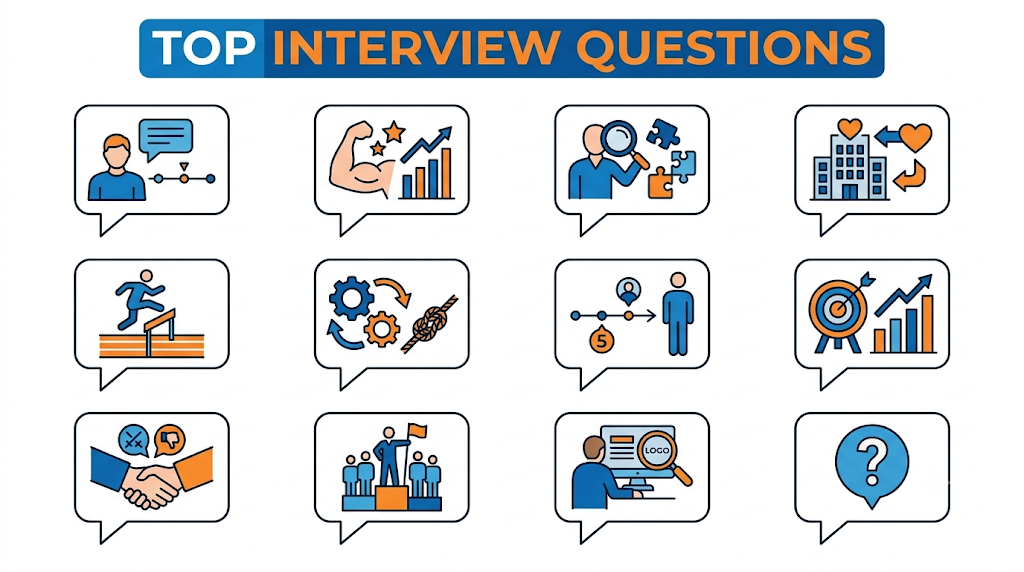
Below are common interview questions you will likely encounter, along with suggestions on what the employer wants to hear and sample answers.
The opening statement determines the first impression. They are checking if you can present your background concisely, clearly, and cheerfully while maintaining eye contact. Example:"Thank you for your time today. Since graduating, I have worked in B2B IT sales for about 3 years, handling everything from new client acquisition to contract negotiations. I want to bring that experience of pursuing both speed and quality to contribute to your company." → Keep it to ~1 minute, stay polite, and highlight points that align with the company.
2. "What are your current job responsibilities?" (仕事内容 - Shigoto naiyou)
Don't just list tasks; weave in your achievements and points where you showed creativity, presented clearly. Example:"I am in charge of men's sales at a fashion boutique. Since customers are quite discerning, I always make sure to understand materials and stitching to provide advice from multiple angles, which helped me meet my sales targets. I was later entrusted with setting up a new store."
3. "What are your strengths?" (長所 - Chousho)
The core should always be common ground with the type of person the company needs. Avoid vague statements like "my passion is second to none." Example:"My strength is always looking for ways to optimize work. In an administrative role, I reviewed the workflow and improved the data management spreadsheets using Excel, then shared that know-how to increase the entire department's efficiency."
4. "What are your weaknesses?" (短所 - Tansho)
Saying "I have no weaknesses" is a taboo (it shows a lack of self-awareness). Choose a weakness where the flip side is a strength, and show your efforts to overcome it. Example:"Because I want to make careful judgments, I can sometimes be a bit hesitant. I am training myself to make decisions both faster and more accurately by practicing a broader view of the data."
5. "What do you value most when working?" (大切にしていること)
Through your policies, they measure your thinking and competence. Avoid obvious answers like "not being late." Example:"I always aim to understand the other party's expectations and try to exceed them, whether it's a client or a colleague. Specifically, I focus on the quality of my work and response speed."
6. "What is the benefit of hiring you?" (採用メリット)
This sounds harsh but it's basically asking for your "Self-PR" while checking your ability to stay calm under pressure. Don't just talk about vague willpower. Example:"I contribute through my ability to propose solutions and my persistence. Although I previously worked as a wedding coordinator, the skill of organizing client needs and building relationships is something I am confident I can bring to this sales position."
💡 Tip: When asked provocative questions, think "they are intentionally testing my reaction," and you will be able to maintain your composure.
7. "What is your reason for changing jobs?" (転職理由 - Tenshoku riyuu)
Don't blame the company or others. Turn "what I hate" into "what I want," and mention what you want to do after switching. Example:"I want to do work that creates direct value for customers. At my current place, it's hard to see the customer's reaction, which has become frustrating. Therefore, I want to move into a role with more customer interaction."
8. "Why do you want to try a role you have no experience in?" (未経験 - Mikeiken)
This question tests your seriousness. Vague reasoning can lead to suspicions that you're "just bored with your old job." Tie it to real experiences. Example:"Seeing the system errors at my current company, I felt frustrated that I always had to rely on an SE to fix them. I want to use my own skills to solve problems for customers facing similar issues."
9. "You left a previous job very quickly; what was the reason?" (短期離職 - Tanki rishoku)
If it was due to the company (downsizing, end of contract), say so directly. If it was your own doing, be honest about the shortcomings and state how you will "prevent it from happening again." Example:"To be honest, I hadn't clearly defined my own career focus when I joined that company. This time, I want to use the skills I've acquired while clarifying my direction for a long-term commitment."
10. "You have changed jobs several times; why?" (転職回数 - Tenshoku kaisuu)
An answer that suggests lack of patience or commitment is NG. Show a consistent purpose and a basis for staying long-term. Example:"Although the number is high, each time I moved, it was in a consistent direction to upgrade my professional skills. Now, I want to use that experience to commit long-term to your company."
📌 Milestones considered "high": 2 times in your 20s, 3 times in your 30s, 4 times in your 40s, and 5+ times in your 50s.
11. "What did you do during your employment gap?" (ブランク)
They are checking your work ethic and health. Mentioning that you were studying or doing related activities is good; if it was due to an illness you've recovered from, affirm that it does not affect your work now. Example:"I focused on recovering from an injury and have now fully recovered. During that time, I also studied for and obtained a Level 2 Bookkeeping certification before starting my job search again."
12. "Why are you applying to our company?" (志望動機 - Shibou douki)
Tests your willpower and the depth of your company research. Avoid generic phrases like "I empathize with the vision" and absolutely avoid mentioning benefits/compensation as a reason. Example:"I find the opportunity to experience various business models here very attractive. I want to leverage my management experience to absorb know-how and eventually progress to a regional manager position."
13. "Why not a competitor in the same industry?" (同業他社)
Find the unique trait of the company and connect it to your roadmap. Example:"I am attracted to the company's strategy for expanding into the Southeast Asian market. I want to produce results domestically first, then participate in that sector, which is why I chose this company over competitors."
14. "What other companies are you applying to?" (他社)
Checks if your career axis is consistent. No need to lie and say "only this company," but don't stray from the axis you've already presented. Example:"I am focusing on buyer positions in the fashion industry. I have a few other applications in progress, but your company is among my top choices."
15. "What do you want to do at our company?" (やりたいこと)
Focus: Will "what you want to do" benefit the company? "I'll do anything" = "I have nothing I want to do." Example:"As a web designer, I want to contribute to solving client problems from a design perspective. I aim to not only design but also actively propose ideas at the product structure stage."
16. "What is your career plan?" (キャリアプラン)
Checks your ambition. Avoid abstraction and avoid personal reasons like "opening my own business in 10 years." Example:"In my 20s, I want to become a full-stack engineer and am currently self-studying Python. After that, I want to continue coding while accumulating project management experience to lead a team as a playing manager."
17. "Finally, do you have any questions for us?" (逆質問 - Gyaku shitsumon)
This is your final PR move. If you are truly interested and have researched well, questions will naturally arise. Aim for 3 or more questions, and avoid asking about benefits or things that can be easily Googled. Good examples:
"Regarding the overseas expansion plan on your website, which distribution channels does the company plan to use?"
"What qualities are needed for a leadership position, and how many years of experience are typically required?"
💡 Avoid saying "No, I don't have any," as it signals low enthusiasm.
18. Practice to speak naturally on the day
(Refer back to the "Practice speaking naturally" section above.) The key point: remember by keywords, perform mock interviews with others, and ask for feedback on your delivery and gestures to catch weak points you might not notice yourself.
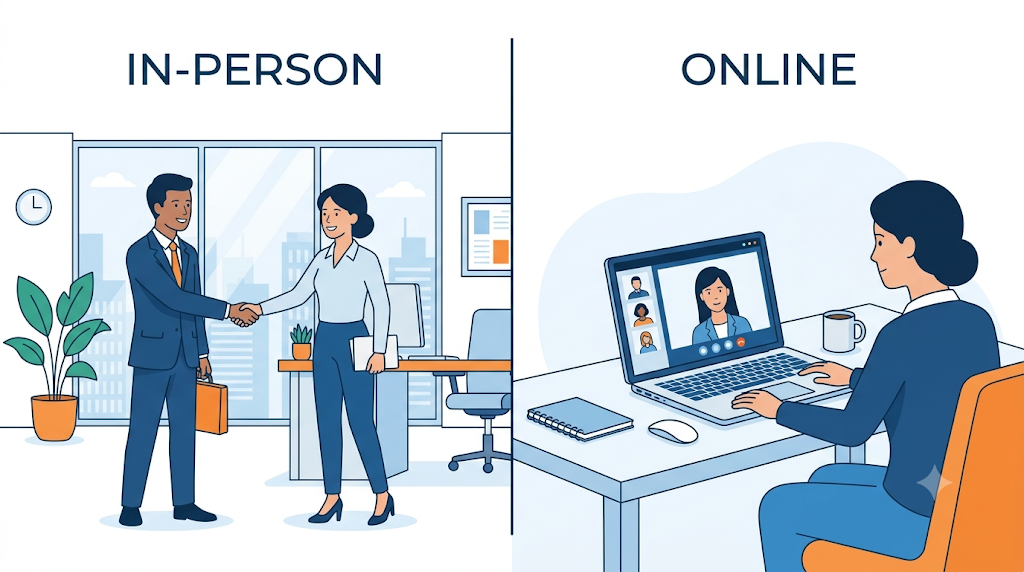
Interview etiquette: In-person and Online
From the perspective of "Can I work with this person?", the impression made by manners and appearance plays a huge role. Failing because of an "untidy appearance" or "restlessness" is actually not uncommon.
In-person Interviews
Appearance: Wear a business suit; ironed shirt, polished shoes, no smell of tobacco or sweat. Perfume can be off-putting, so it's best not to use any.
Arrival time: Reach the reception about 5 minutes before the appointment. Arriving too early (>10 minutes) is also a minus. If you are late due to public transport, you must call the person in charge.
In the room: Knock 3 times before entering, say "Shitsurei-shimasu"; sit only when invited; receive business cards with both hands and bow in thanks; turn off your phone; maintain eye contact, keep a slight smile, sit straight, and never interrupt.
💡 Most recruiters believe appearance affects the results, but "appearance" here is not about looks, but rather the level of care and grooming you demonstrate.
Online Interviews (Web)
Expressions: Passion is harder to convey through a screen, so speak clearly and more cheerfully than in person, nod noticeably, and give clear reactions.
Background: Sit in a quiet room at home, set your display name to your full name, and use a plain wall background (avoid virtual backgrounds as they can cause visual glitches when you move).
Eye contact: Set your camera at eye level (use a phone stand if necessary); when speaking, look at the camera, not down at the screen.
Operations: Log in 5–10 minutes early, use a headset with a mic, do not record or take screenshots, and if you encounter connection issues, call the emergency contact number you prepared immediately and apologize once reconnected.
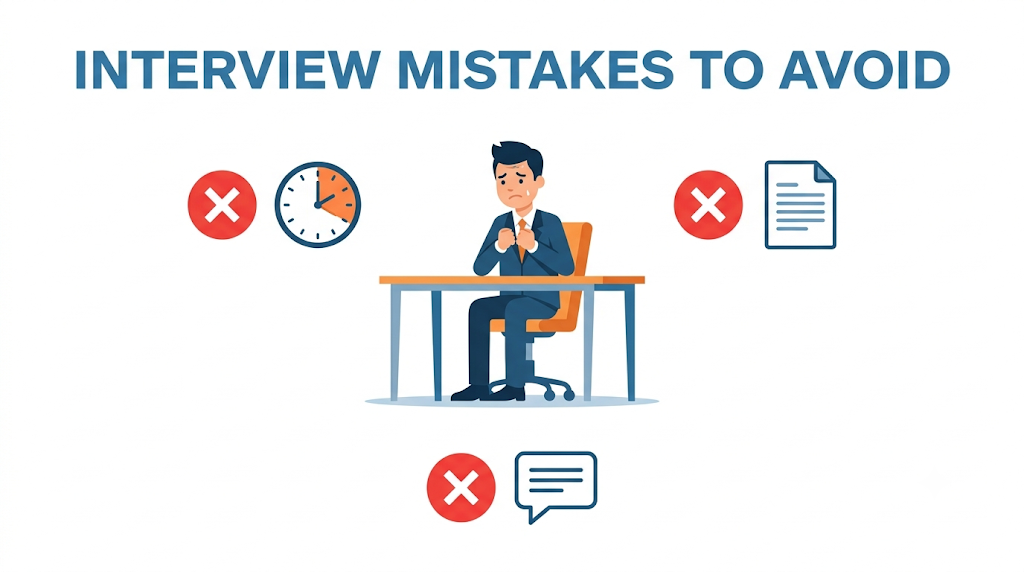
Common reasons for failing an interview
While reasons for passing are diverse, reasons for failing tend to follow a fixed pattern. Know these beforehand to avoid them:
Negative reasons for leaving / blaming others; failure to reflect properly on the resignation process.
Stopping at "wanting to change the current environment" without knowing what you actually want to do; or what you want to do is too abstract ("level up skills," "gain more knowledge").
Only thinking from your own perspective; having vague desires without the effort to realize them.
Applications to disjointed industries/roles → lack of consistency; a focus on "where the benefits are best," making it hard to feel your desire to join this specific company.
Getting the interview time wrong; arriving late without notice, or arriving late and walking in without apologizing.
Not listening to the company introduction / showing a lack of interest, such as resting your chin on your hand while listening.
Sounding like you're reading a script, with no genuine emotion; speaking over the other person; nodding too rapidly as if rushing them.
Online interviews: sitting in a car without notice; display name/background being too personal; audible keyboard typing sounds.
Pre-interview Checklist
Researched the company (past – present – future, strengths, culture) and tried the service if possible.
Drafted and practiced speaking aloud for common questions.
Self-introduction is condensed into ~1 minute.
Reason for leaving – Motivation – Self-PR are consistent with each other.
Prepared 3 or more reverse questions that show ambition (avoid asking about benefits).
Checked attire and items to bring; for Web interviews, tested connection, camera, and audio.
Have the emergency contact number ready for any incidents.
Japan Job Interview Handbook
This PDF file contains the entire process from preparation, company research, a set of common questions with sample answers, to interview day etiquette for both in-person and online interviews.
A job interview in Japan is not a "recitation" but a dialogue to prove that you and the company are a good match. Remember three things: maintain consistency between your reason for leaving – motivation – self-PR, research the company deeply enough to be specific, and practice speaking naturally instead of memorizing by rote. By preparing well for the questions above, you are already ahead of most other candidates.
Good luck! Stay confident and we hope you receive your dream job offer soon!
Hello everyone. I'm an IT engineer working in Japan. I created this blog to share about life and experiences during my study and work journey. I hope this article will be helpful to you.