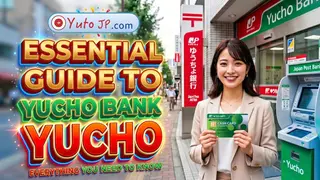













When living in Japan, sooner or later you will need a Yucho Bank (ゆうちょ銀行 / Japan Post Bank) account to receive your salary, pay utility bills, receive transfers from friends, or send money home to your family. This is the most popular bank for foreigners in Japan because it is easy to open, has ATMs everywhere, and is very beginner-friendly for those who have just arrived.
What is Yucho Bank? Should You Use It?
Yucho is part of the Japan Post Group, established after the privatization of the postal savings system in 2007. It is one of the banks with the largest deposit volumes in Japan and is one of the very few banks with service points in all 47 prefectures, meaning you can find a Yucho branch or ATM no matter where you go in Japan.
Why foreigners often choose Yucho as their first bank account:
- Easy to open with simple procedures at your local post office.
- ATMs and post offices are located everywhere, even in rural areas, so you don't have to travel far to withdraw or deposit money.
- No account maintenance fees for regular use.
- Excellent integration with local services: receiving salary, automatic bill payments, and linking to e-wallets.
Types of Yucho Savings Accounts
When opening a Yucho account, you will encounter several types of "貯金" (savings/deposits). For most newcomers, the first type is all you need:
- 通常貯金 (Ordinary Deposit): The main account for receiving salary and daily withdrawals/deposits. This is the most common type and comes with an ATM card and a passbook.
- 通常貯蓄貯金 (Savings Deposit): For saving money; the interest rate is slightly higher for large balances, but it cannot be used for direct salary deposits or automatic payments.
- 定期貯金 (Time Deposit): Fixed-term deposits with higher interest rates; there are penalties for withdrawing before the term ends.
- 定額貯金 (Fixed-Amount Deposit): Long-term accumulation for up to 10 years, can only be withdrawn after 6 months, with compound interest.
Just open a 通常貯金 (Ordinary Deposit); this is the account that comes with an ATM card (キャッシュカード) and a passbook (通帳) that you will use every day. You can think about the other types later when you want to start saving.
How to Open a Yucho Bank Account
Go to a post office (郵便局) with a banking counter and bring: your valid residence card (在留カード), your personal seal (印鑑 / Inkan) (some branches may allow a signature, but a seal is more reliable), proof of address, and a Japanese phone number. The staff will provide you with detailed instructions.
Note for newcomers: If you have been in Japan for less than 6 months, the counter may ask for additional documents such as an employee ID or school enrollment certificate for verification—it's better to bring extra than to be missing something. Post office banking counters close early (usually at 4:00 PM on weekdays), so don't go too late.
Free Internet Banking - Yucho Direct
Yucho Direct (ゆうちょダイレクト) allows you to check your balance, view transaction history, transfer money online, register for international transfers, and set up automatic payments—doing almost everything from your phone without having to queue at the post office. Additionally, there is a Passbook App (ゆうちょ通帳アプリ) for quick balance checks. For those working in Japan, registering for Yucho Direct is almost essential, and it is also the cheapest way to make domestic and international transfers compared to going to the counter.
Domestic Transfers (Furikomi)
There are two main scenarios:
- Yucho → Yucho: You only need the recipient's 記号 (Kigo - code) and 番号 (Bango - number). Fees are cheap (and there is a monthly limit for free transfers depending on certain conditions).
- Yucho → Other Banks: You will need the bank code, branch code, and account number. The fees for this are higher.
It is always better to prioritize online transfers for speed and convenience.
☒
Sending Money Abroad from Yucho (International Remittance)
Yucho offers an "International Remittance Service" (ゆうちょの国際送金), allowing you to send money online via computer or smartphone to many countries. Previously, international transfers mostly required visiting the counter, which was both expensive and slow; now, doing it online is much smoother.
Intermediary fees (仲介手数料) may be deducted from the amount reaching the recipient depending on the receiving bank abroad, meaning your family might receive less than the amount you sent. Bank exchange rates are also typically not as favorable as those from specialized money transfer services.
Therefore, if you send money home regularly, don't just default to Yucho. Compare it with DCOM, SBI Remit, or other remittance channels. Often, a better exchange rate combined with transparent fees ensures your family receives significantly more. There is no one-size-fits-all answer: it depends on the amount, frequency, and speed you need.
- Sending money from Japan abroad via DCOM service
- Registering for an SBI Remit card to transfer money from Japan abroad
Frequently Asked Questions
Can newcomers to Japan open a Yucho account?
Yes, you just need a valid residence card and basic documents; if you have been in Japan for less than 6 months, you may be asked for extra documentation.
Yes, you just need a valid residence card and basic documents; if you have been in Japan for less than 6 months, you may be asked for extra documentation.
Does Yucho charge account maintenance fees?
For regular usage, there are no maintenance fees.
For regular usage, there are no maintenance fees.
Is it cheap to send money abroad through Yucho?
You can send money online very conveniently, but for regular transfers, you should consider using DCOM or SBI Remit.
You can send money online very conveniently, but for regular transfers, you should consider using DCOM or SBI Remit.
Conclusion
A Yucho Bank account is one of the most essential things when you first arrive in Japan—open it once and use it for the long term. Having a Yucho account will make your life in Japan much more convenient.
I hope this article helps clear up some of your concerns as a newcomer. If you found it helpful, feel free to share it with your friends!
I hope this article helps clear up some of your concerns as a newcomer. If you found it helpful, feel free to share it with your friends!